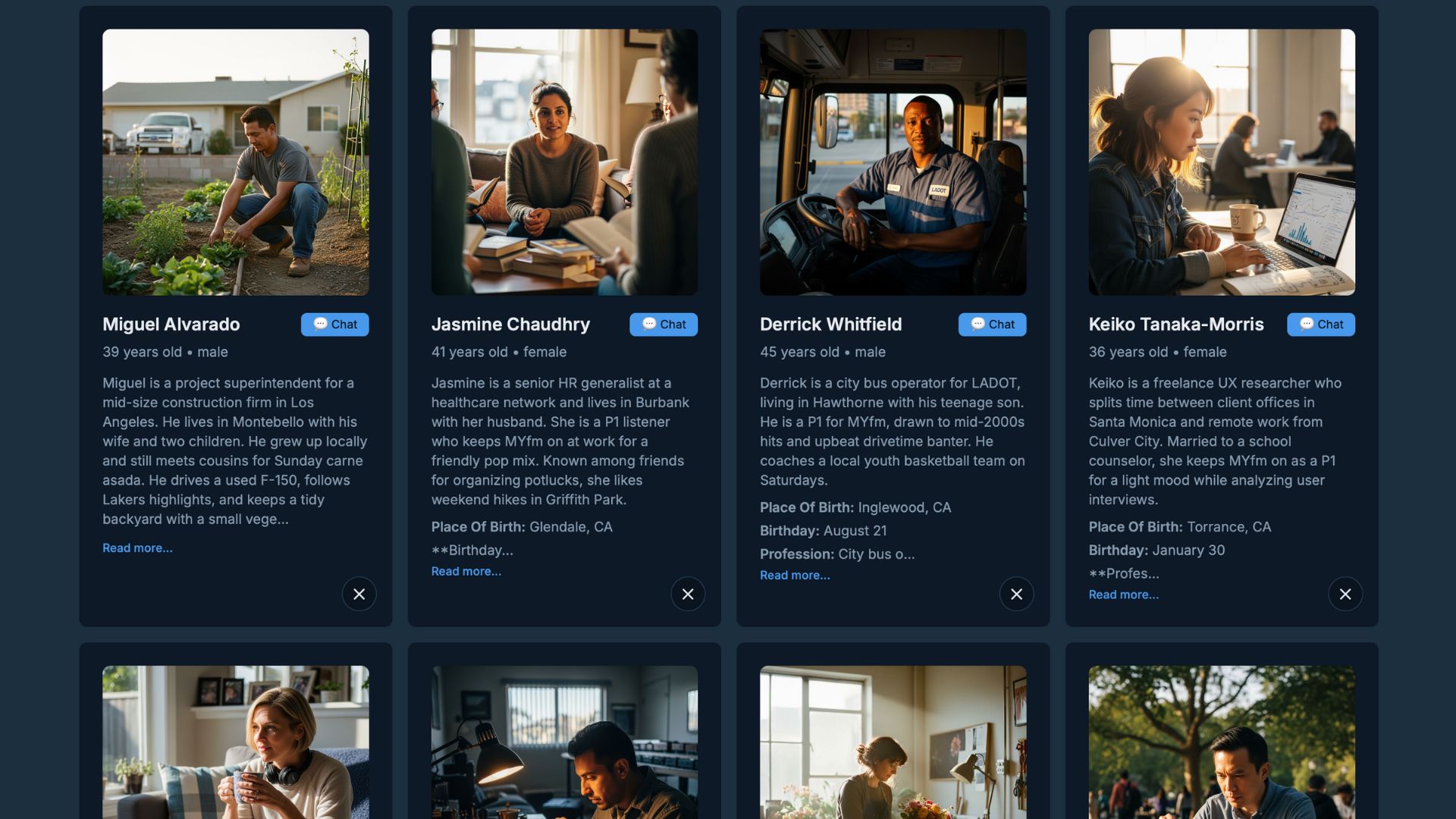
More than half of market researchers now use data-modelled audience panels to broaden their scope and accelerate insights. That is the finding from Forbes Tech Council's September 2025 survey of the research industry. The shift started in retail and consumer goods. Beauty brands, food companies, and fashion houses have figured out that building a panel of virtual consumers from real-world data is faster, cheaper, and, when built correctly, as accurate as running a live panel.
The methodology is now crossing into media. And radio has always run on tight research budgets and slow turnaround times. This is exactly why this matters for the radio industry.
Instead of recruiting 500 real listeners, and spending three weeks on fieldwork, you build a precise digital model of your audience from real data. Not personal data. Real cultural patterns, listening behaviours, social media signals, census sources, news consumption, and public forums, thousands of data sources combined into lifelike audience models that react and evolve the way real listeners do.
The model is built on behavioural probabilities derived from real-world data. AI is used to translate those probabilities into human language, not to invent opinions. This is hard data probabilities built off real-world data, which then uses an AI LLM to turn those probabilities into understandable human language. It's not a chatbot.
Harvard Business Review's November 2025 analysis found that digitally mathematically generated audience proxies dramatically reduce the time and cost of traditional research while producing insights comparable to those from real human panels.
We ran this test ourselves. We built a modelled audience panel for L'Oréal. L'Oréal ran the exact same study simultaneously using a real human panel. When the results came back, the overlap between the two sets of findings was 95%. That is not a rounding error. It is a validation.
The modelled panel produced research-grade insight at a fraction of the time and cost of the human equivalent. L'Oréal did not need to choose between speed and accuracy. Neither does a radio station.
Behind this work is François Pachet, our Director of Technology. François is a pioneering researcher at the intersection of machine learning, creativity, and audience understanding. A former lab director in Europe and the U.S., he has led groundbreaking work at Sony Computer Science Lab and Spotify's Creator Technology Research Lab, where he explored how technology can model emotion and creative behavior. He designs the systems that help media leaders decode audience reactions and make confident, insight-driven decisions.
Some media groups are already ahead of this curve. NGroup in Belgium, the company behind NRJ and Nostalgie, is among the first European radio groups to adopt audience modelling as a live decision-making tool. Kim Beyns, CEO of NGroup, describes what it changes at the top of the organisation:
“Audience modeling gives us something every media CEO wants: clarity before we commit. Instead of guessing how listeners might react to a new show, a presenter, or a bold programming move, we can simulate hundreds of listeners and watch their reactions unfold. It's like having a living audience in the room helping us make smarter decisions for our stations.”
For programming and branded content, it is incredibly powerful. Teams can simulate how listeners react to a morning show feature, a client activation, or even a TV spot before it goes live.
Jean Pierre Cremers, Marketing Director of NGroup, puts his finger on the deeper shift:
“What audience modelling also changes permanently is how research is categorised. Every question you ask a virtual panel is now both quantitative and qualitative at the same time.”
He is right. Ask why a listener is drifting away from your breakfast show, and you get a number and the reason. Ask which promo concept lands best with 25 to 34-year-old commuters, and you get a ranking and the emotional logic driving it.
Quantitative and qualitative used to be two separate budgets, methodologies, and timelines. With audience modelling, they are one answer.
For a radio station, the practical list of things you can test this way is longer than most programmers have considered. Station promos and imaging. TV spots. Music formats and music genres. Social media video concepts. New hosts. Chemistry between hosts. New show formats. Break structures. Positioning lines.
You can build a modelled panel of your current listeners and test whether a new morning show concept holds or alienates them. You can build a panel of non-listeners in your target demographic and test what would actually bring them in. You can build a panel of your top twenty advertiser categories and test which sales packages and audience arguments land most convincingly.
The New York Times used this approach in 2025 to model virtual focus groups from its own subscriber base, finding the accuracy strong enough to inform editorial decisions without a single in-person session.
The sales angle is the one most radio groups have not yet fully explored. Modelled panels built from prospect data let a sales team walk into a client meeting with pre-tested evidence: here is how a representative panel of your target customers responded to your ad concept on our station, before you spent a penny on airtime.
That is a fundamentally different conversation from a rate card and a reach number. It shifts the sales relationship from media buying to a genuine strategic partnership.
The predictive audience tools available today, built on real behavioural data that can be validated against human panels, make that conversation possible at a cost that was unthinkable five years ago. The stations that start using these tools this year will be harder to replace than any station that just sells spots.